
What’s Leaking From My Car?
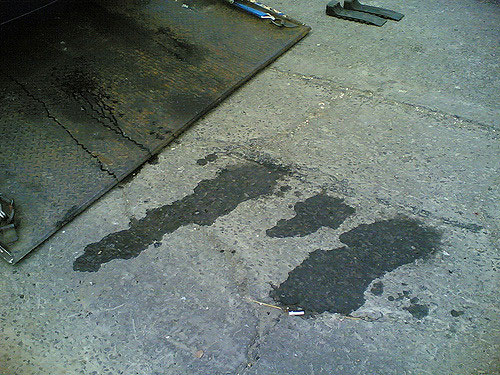
You go out to your car, start it up, pull out of your parking space and see a puddle of…something…where you were parked a moment ago. This is never a good feeling. What could it be?
Fortunately, some automotive fluids are dyed different colors to make this a little easier to narrow down.
Does it appear to be water? Were you recently running your A/C? Chances are that’s just condensation from the A/C system, which drips out through a rubber tube and is perfectly normal. No worries there.
For years, antifreeze was dyed a bright green to make it easy to identify. Today, other antifreeze formulations can be colored pink or orange, but it’s still not hard to figure out — antifreeze has a sweet-ish, unmistakable smell due to its ethylene glycol content.
Gasoline is a pale yellowish or orange color, and also has a distinct smell that you’ll recognize right away. Gasoline evaporates quickly and may feel cool on your finger if you dip it into the puddle. It’s also, of course, very flammable!
Motor oil is honey-colored or perhaps darker, depending on how long it’s been in the engine, and is slippery when rubbed between thumb and forefinger. Transmission fluid has the same slippery feeling as motor oil, but is dyed a magenta color and may have a somewhat sweet smell.
Power steering fluid is clear and often may feel more slippery than motor oil. Brake fluid is also very slippery and may have a more hazy yellowish color.
What to Do About a Leak
If you regularly see a puddle under your vehicle that’s bigger than an inch or two across, slide a sheet of cardboard under the engine and between the front wheels when you park it in the evening.
Leaks can be difficult to pin down on a vehicle that’s already grimy and oily underneath (especially since the path of the leak will be blown backwards while driving). One way to isolate the source of a leak is to safely lift and secure the vehicle, get underneath it and clean the bottom of the engine and transmission with brake cleaner or a similar solvent. Spray the entire area with foot powder, which should then clearly show where the leak is originating.
Leaks can be troubling, but older vehicles with high mileage tend to have gaskets and seals which dry up and shrink, causing at least minute leaks. Got any concerns? Make an appointment with us and let us track down that leak and fix it!